Small businesses in India are growing faster than ever before. However, securing adequate funding continues to be one of the biggest hurdles for local shop owners, freelancers, startups, and service providers.
While many entrepreneurs have brilliant business ideas, growing customer demand, and established digital sales channels, they often lack commercial property or physical assets to pledge against traditional bank loans.
That is exactly why collateral-free MSME loans have become a vital financial lifeline in 2026. Today, public sector banks, private financial institutions, NBFCs, and government-backed schemes evaluate your business based on performance, GST activity, digital transactions, and banking discipline—rather than relying solely on physical collateral.
This major shift is opening up incredible new growth opportunities for Indian entrepreneurs.
Quick Answer
Indian MSMEs can apply for collateral-free loans in 2026 through banks, NBFCs, Mudra loans, and CGTMSE-backed schemes by submitting their Udyam registration, KYC documents, bank statements, and GST records. Instead of property collateral, lenders evaluate your business cash flow, repayment history, and digital transaction activity to approve the funding.
What Is a Collateral-Free MSME Loan?
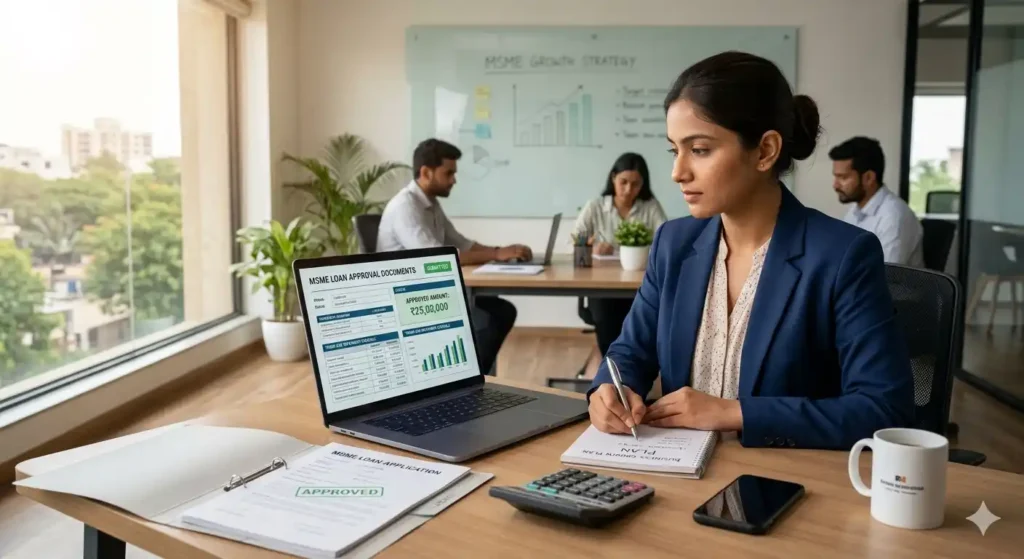
A collateral-free MSME loan is a specialized business credit facility where entrepreneurs do not need to pledge property, machinery, gold, or fixed assets as security. Instead of focusing on physical assets, modern lenders assess your eligibility through alternative financial indicators:
- Monthly and annual business turnover
- Regularity in GST filings
- Historical banking behavior and cash flow consistency
- Existing liabilities and debt obligations
- CIBIL credit score and digital transaction footprints
These loans are commonly structured and distributed under prominent initiatives like the CGTMSE scheme, Mudra Yojana, specialized fintech lending platforms, and dedicated MSME financing programs.
Why MSME Loans Are Important for Indian Businesses in 2026
India’s small business ecosystem is expanding rapidly, fueled by the massive adoption of UPI, digital commerce channels, and pro-entrepreneurship government policies.
However, managing rising operational costs, inventory expenses, marketing budgets, and delayed customer payments can create severe working capital pressure.
Collateral-free business loans solve this issue by providing quick funds to purchase raw materials, upgrade essential equipment, hire skilled staff, manage seasonal demands, and expand your digital storefront safely.
Who Can Apply for Collateral-Free MSME Loans?
The eligibility criteria have widened significantly to support various business models across India:
- Micro Businesses: This includes local grocery stores, tailoring shops, salons, repair centers, and neighborhood service providers.
- Small Businesses: Established manufacturers, traders, retailers, boutique digital agencies, and professional firms.
- Startups & Digital Creators: Independent freelancers, online consultants, e-commerce sellers, cloud kitchens, and emerging SaaS startups.
- Women Entrepreneurs: Most financial institutions and government schemes offer special concessions, lower interest rates, and dedicated support programs for women-led businesses.
Best Collateral-Free MSME Loan Schemes in India
1. CGTMSE Loan Scheme
The Credit Guarantee Fund Trust for Micro and Small Enterprises (CGTMSE) is a major government initiative that provides credit guarantees to financial institutions, encouraging them to deliver collateral-free funding to growth-stage startups and manufacturing units.
- Official Portal: CGTMSE Official Website
2. Mudra Loan Scheme
Designed primarily for new entrepreneurs, local shop owners, and first-time borrowers, the Pradhan Mantri Mudra Yojana offers tiered funding based on your business stage:
- Official Portal: Mudra Yojana Portal
| Category | Loan Amount | Best Suited For |
| Shishu | Up to ₹50,000 | New setups and micro-vendors |
| Kishore | ₹50,000 to ₹5 Lakh | Established local businesses looking to expand |
| Tarun | ₹5 Lakh to ₹10 Lakh | Small businesses requiring stable working capital |
3. PSB Loans in 59 Minutes
An advanced digital platform that allows small businesses to get an in-principle loan eligibility check from multiple public and private sector banks in under an hour.
- Official Portal: PSB Loans in 59 Minutes
Step-by-Step Process to Apply for an MSME Loan
Step 1: Complete Udyam Registration
Your first step should always be registering your business on the government’s official portal. It strongly improves your financial credibility and opens doors to interest subventions and subsidy benefits.
- Official Portal: Udyam Registration Portal
- Required Data: Aadhaar, PAN, active mobile number, and basic business details.
Step 2: Evaluate Your Eligibility
Before approaching a lender, check your credit profile. Lenders will thoroughly analyze your business age (usually minimum 1 to 2 years), revenue stability, and credit history.
Step 3: Prepare the Complete Document Framework
Having your documents organized beforehand dramatically speeds up the approval process.
- Personal KYC: Aadhaar card, PAN card, address proof, and recent photographs.
- Business Registration: Udyam certificate, GST registration, shop establishment license, or partnership deed.
- Financial Records: Past 6 to 12 months’ bank current account statements, latest GST returns, and Income Tax Returns (ITR).
Note for Brand New Startups: If your business is new, lenders will require a comprehensive project report containing a viable business plan, realistic revenue projections, promoter profiles, market analysis, and genuine vendor quotations.
How Lenders Evaluate Loan Applications in 2026
Modern lending systems heavily leverage digital underwriting algorithms. Financial institutions look closely at specific indicators:
- GST Turnover Consistency: Regular, transparent filings indicate a highly active and reliable business model.
- Banking Discipline: Maintaining a healthy average monthly balance and keeping a clean record free of cheque bounces signals lower risk.
- UPI and Digital Payment Footprints: A steady stream of online customer collections provides direct, verifiable proof of your daily sales volume.
- Existing Debt Burdens: Keeping your current business liabilities low relative to your income heavily improves your loan eligibility.
Realistic Business Case Study
Consider a custom gifting enterprise based in Jaipur that operates primarily through Instagram and WhatsApp. During the peak Diwali festive season, the founder witnessed a massive surge in bulk corporate orders.
However, they lacked the capital to secure raw materials and hire extra seasonal staff. Without any commercial property to offer as security, the founder applied for a collateral-free Mudra loan using their digital transaction history and Udyam profile.
The timely funding allowed the business to scale up its production, fulfill all orders on time, and successfully double its seasonal revenue.
Choosing the Right Financial Partner
Understanding the differences between lending institutions helps you choose the best partner for your business goals:
| Feature | Public & Private Sector Banks | NBFCs & Digital Lenders |
| Interest Rates | Generally lower and more affordable | Relatively higher due to risk profiling |
| Processing Speed | Moderate; involves meticulous checks | Very fast; often fully automated digital approvals |
| Documentation | Highly detailed financial compliance | Flexible and streamlined digital process |
| Startup Friendliness | Moderate; prefers proven operational history | High; focuses on modern digital cash flows |
Leading Lenders in the Market
- Public Sector: State Bank of India (SBI), Punjab National Bank (PNB), Bank of Baroda.
- Private Sector: HDFC Bank, ICICI Bank, Axis Bank.
- NBFCs & Fintechs: Lendingkart, NeoGrowth, IIFL Finance.
Interest Rates for MSME Loans in 2026
Interest rates for unsecured business loans vary based on your financial strength, operational sector, and credit history. Generally, interest rates range across the market:
Typical Market Rates: 9% to 22% per annum While traditional public sector banks lean toward the lower end of this spectrum, digital NBFCs charge higher rates in exchange for faster processing, flexible terms, and minimal documentation.
Common Reasons for Application Rejection
- Poor Banking Hygiene: Frequent instances of balance insufficiency or recurring cheque bounces.
- Sub-par Credit Scores: A weak personal or business CIBIL score due to delayed credit card or past loan repayments.
- Document Mismatches: Discrepancies in names, addresses, or numbers across PAN, Aadhaar, and GST filings.
Inflated Projections: Presenting unrealistic business growth charts without historical or market evidence to support the numbers.
Expert Tips to Maximize Your Approval Chances
- Maintain Clear Boundaries: Separate your personal and business finances immediately by utilizing a dedicated business current account for all professional revenue.
- Encourage Digital Collections: Shift your business away from cash-only systems. Processing your sales through UPI, net banking, or POS machines creates a verifiable digital trail that lenders trust.
- File Compliance Documentation Regularly: Ensure your GST and ITR filings are completed on time, as automated credit checks pull this data instantly.
- Borrow Wisely: Start with realistic, moderate loan amounts that match your actual repayment capacity to build a strong foundational credit history
Pros and Cons of Unsecured MSME Funding
Advantages
- Zero Asset Risk: You do not have to put your personal home or business property on the line.
- Accessible to Startups: Enables first-generation entrepreneurs to raise capital purely on business potential.
- Versatile Usage: The funds can be dynamically deployed across inventory, marketing, equipment, or hiring.
Disadvantages
- Premium Cost: Carries higher interest rates compared to traditional property-backed secured loans.
- Strict Digital Scrutiny: Requires clean, compliant electronic financial records for processing.
- Conservative Initial Limits: First-time borrowers might receive smaller credit limits until trust is established.
Future Trends in Small Business Lending
The Indian lending landscape is undergoing a massive transformation powered by advanced AI underwriting tools, deep integration with the Goods and Services Tax network, and the growing Account Aggregator framework. These technological advancements ensure that access to capital will become smoother, more transparent, and significantly faster for grassroots businesses, creators, and freelancers over the coming years.
Frequently Asked Questions (FAQs)
1. Can newly launched startups secure collateral-free MSME loans?
Yes, emerging startups can access funding under government guarantee schemes like CGTMSE or Mudra by presenting a detailed, viable project report alongside proper Udyam registration.
2. Is a GST registration mandatory for an MSME loan?
It is not always mandatory for smaller loan brackets (like Mudra Shishu loans). However, possessing an active GST registration vastly improves your financial credibility and increases your borrowing limit.
3. What is the maximum cap for collateral-free MSME financing?
Under the revised government guidelines for schemes like CGTMSE, credit guarantees can cover business loan limits up to several crores, depending entirely on the lender’s internal policies and your business transaction health.
4. How long does the fund disbursement process take?
Fintech lenders and digital NBFCs can process and disburse loans within 24 to 48 hours. Traditional commercial banks may take anywhere from a few days to a couple of weeks to complete their financial evaluations.
5. Are independent freelancers eligible to apply for MSME loans?
Yes, service providers, independent consultants, and digital content creators can register as micro-enterprises on the Udyam portal and apply for professional business financing.
Final Thoughts
Collateral-free MSME loans in 2026 are actively bridging the gap between ambitious business ideas and capital restrictions. The modern banking system is looking beyond brick-and-mortar assets, focusing instead on consistent cash flows, tax compliance, and transactional integrity.
By keeping your financial records clean, embracing transparent digital payment methods, and borrowing strategically, you can smoothly navigate the application process and fuel your business growth effectively.
Disclaimer: This article is for educational and informational purposes only. We do not provide loans, lines of credit, or formal financial advice. Readers are highly encouraged to verify all terms, processing fees, and interest rates directly on the official government or banking portals before submitting a loan application.
Also Read – Growth Plan of a Business: How Indian Entrepreneurs Can Scale

Founded in 2026 by Rajiv Rawat, Businessbadhao has grown from a simple vision into a platform dedicated to delivering valuable insights and high-quality content. What began as a passion for sharing knowledge and helping businesses grow has evolved into a trusted source of information for entrepreneurs, professionals, and ambitious individuals.