Learn how to find reliable B2B distributors for new consumer products with practical strategies for business growth, retail expansion, and long-term distribution success
Launching a new consumer product in India is exciting, but finding reliable B2B distributors can often become one of the biggest challenges for startups, manufacturers, and growing brands.
Many businesses successfully create quality products but struggle to scale because they cannot build a strong distribution network.
Without reliable distributors:
- products may not reach the right markets,
- retailer relationships become inconsistent,
- inventory movement slows,
- and business growth becomes difficult.
That is why understanding how to find reliable B2B distributors for new consumer products is extremely important for Indian businesses in 2026 and beyond.
Whether you are:
- a startup founder,
- FMCG manufacturer,
- D2C brand owner,
- private label business,
- importer,
- wholesaler,
- or small business entrepreneur,
this guide will help you understand practical and realistic distributor acquisition strategies suitable for the Indian market.
What Is a B2B Distributor?
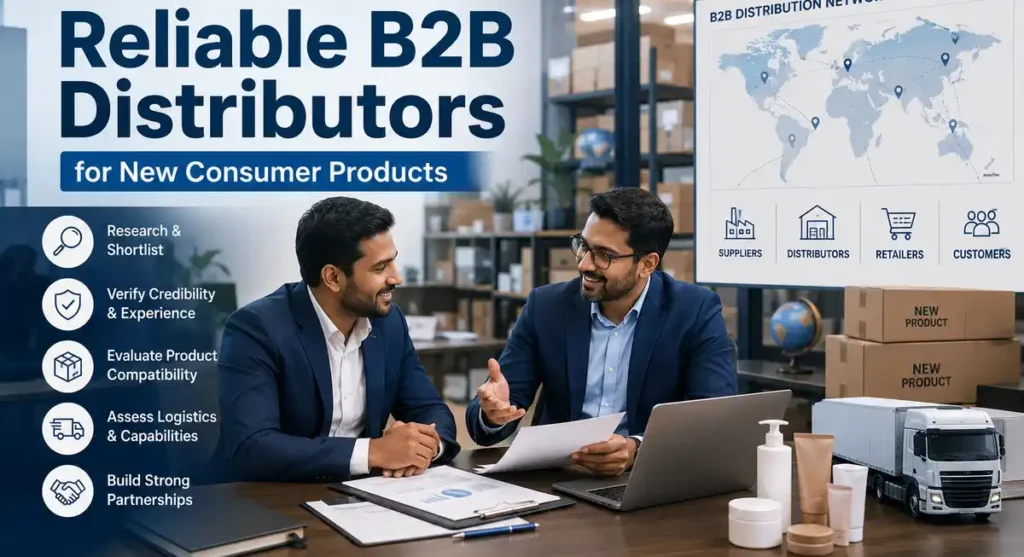
A B2B distributor is a business that purchases products from manufacturers or brands and supplies them to:
- retailers,
- wholesalers,
- dealers,
- ecommerce sellers,
- supermarkets,
- pharmacies,
- local stores,
- or institutional buyers.
Distributors help businesses expand into new markets without building a direct sales infrastructure everywhere.
They often manage:
- inventory movement,
- retailer relationships,
- local logistics,
- payment collections,
- and market expansion.
Why Reliable Distributors Matter for Business Growth
Many businesses underestimate how important distributor quality is.
A poor distributor can create:
- delayed payments,
- weak market penetration,
- retailer dissatisfaction,
- poor product visibility,
- and damaged brand reputation.
On the other hand, strong distributors may help:
- improve product reach,
- accelerate market expansion,
- build retailer trust,
- increase repeat orders,
- and improve operational stability.
In India’s highly competitive consumer market, distribution quality often becomes a major growth differentiator.
What Makes a Good B2B Distributor?
Not every distributor is suitable for every product category.
Reliable distributors usually have:
- strong retailer relationships,
- market experience,
- operational discipline,
- local market understanding,
- and healthy financial capacity.
Key Qualities to Evaluate
Market Reach
Good distributors already supply:
- retailers,
- local stores,
- supermarkets,
- or institutional buyers.
Product Category Experience
A cosmetics distributor may not perform well for electronics products.
Industry specialization matters.
Payment Discipline
Reliable payment cycles are critical for business stability.
Logistics Strength
Strong distributors manage:
- warehousing,
- delivery systems,
- inventory movement,
- and retailer servicing efficiently.
Retailer Relationships
Distributor trust in local markets directly affects product adoption.
Step-by-Step Process to Find Reliable B2B Distributors
Step 1: Define Your Target Market
Before searching for distributors, identify:
- your product category,
- ideal retailer type,
- pricing segment,
- target geography,
- and customer profile.
Questions to ask:
- Is your product premium or mass-market?
- Which cities have highest demand potential?
- Are you targeting modern retail or traditional retail?
- Is your product suitable for Tier 2 or Tier 3 markets?
Without clarity, distributor selection becomes difficult.
Step 2: Build a Strong Product Presentation
Distributors evaluate products professionally.
Before approaching them, prepare:
- product catalog,
- pricing sheets,
- margin structure,
- product samples,
- GST details,
- marketing plans,
- and retailer demand strategy.
A poorly presented business may reduce distributor confidence.
Step 3: Use B2B Marketplace Platforms
Several B2B platforms help businesses discover distributors and wholesale buyers.
Popular Indian B2B platforms include:
- IndiaMART
- TradeIndia
- Udaan
- ExportersIndia
These platforms may help identify:
- wholesalers,
- distributors,
- stockists,
- and regional trade partners.
However, businesses should verify distributor credibility carefully.
How to Verify Distributor Reliability
One of the biggest mistakes businesses make is trusting distributors too quickly.
Verification is extremely important.
Check Business Registration
Verify:
- GST registration,
- company identity,
- trade licenses,
- and operational history.
Ask for Existing Brand References
Reliable distributors usually already work with recognized companies.
Ask:
- which brands they currently distribute,
- retailer coverage details,
- and territory performance.
Evaluate Retail Network
A distributor with weak retailer connections may struggle to scale your product.
Check Financial Stability
Late payments can damage cash flow significantly.
Evaluate:
- payment cycles,
- credit expectations,
- and market reputation.
Visit Their Warehouse
Physical verification often reveals:
- operational quality,
- inventory systems,
- and logistical capability.
Best Ways to Find B2B Distributors in India
1. Trade Shows and Business Exhibitions
Trade fairs remain one of the best methods for finding serious distributors.
Popular Indian exhibitions include:
- FMCG expos,
- food exhibitions,
- beauty trade shows,
- retail expos,
- and startup networking events.
Advantages:
- face-to-face trust building,
- live product demonstration,
- faster business discussions,
- and relationship development.
2. Retail Market Research
Visit wholesale markets directly.
Observe:
- competing products,
- retailer demand,
- distributor brands,
- and market pricing.
Examples:
- Delhi wholesale markets
- Mumbai FMCG markets
- Ahmedabad distribution hubs
- Bengaluru electronics markets
Ground-level research provides practical market understanding.
3. LinkedIn Networking
LinkedIn has become valuable for B2B relationship building.
You can connect with:
- distribution managers,
- wholesalers,
- retail chain executives,
- and regional sales professionals.
Professional networking improves credibility.
4. Industry Associations
Business associations often help connect manufacturers with trade networks.
Examples:
- FICCI
- CII
- local chamber of commerce groups
- MSME associations
5. Existing Retailers
Retailers often know active distributors in their region.
This can become one of the most reliable referral sources.
Common Distributor Models in India
Super Stockist Model
A super stockist supplies products to smaller distributors across regions.
Best for:
- large-scale FMCG expansion,
- multi-state operations,
- and fast-moving products.
Regional Distributor Model
Regional distributors handle specific territories.
Best for:
- startups,
- emerging brands,
- and controlled expansion.
Exclusive Distributor Model
One distributor receives exclusive rights for a region.
Advantages:
- stronger commitment,
- focused growth,
- and accountability.
Risk:
- overdependence on one partner.
Distributor Margin Strategy
Margins play a major role in distributor motivation.
Typical margin considerations include:
- distributor margin,
- retailer margin,
- promotional support,
- scheme incentives,
- and logistics costs.
Low margins may reduce distributor interest.
However, unsustainable margins can hurt profitability.
Balanced economics are important.
Mistakes to Avoid While Appointing Distributors
Choosing Only Based on Size
Large distributors may ignore smaller brands.
Sometimes mid-sized focused distributors perform better.
Giving Large Credit Periods Too Early
New businesses should manage payment risk carefully.
Expanding Too Fast
Aggressive expansion without operational systems can create inventory and servicing issues.
Ignoring Retail Demand
Distributor appointment alone does not guarantee sales.
Consumer demand generation is equally important.
Weak Communication
Distributors need:
- product training,
- pricing clarity,
- marketing support,
- and operational coordination.
How D2C Brands Can Build Offline Distribution
Many Indian D2C brands now expand offline after building online traction.
Offline expansion strategies include:
- pharmacy chains,
- supermarkets,
- cosmetic stores,
- wellness retailers,
- and general trade networks.
Brands often use:
- social proof,
- online reviews,
- influencer visibility,
- and ecommerce success
to convince distributors.
Technology Tools That Help Distributor Management
Modern businesses increasingly use software for distributor operations.
Useful tools include:
- CRM systems,
- ERP software,
- inventory management tools,
- retailer ordering apps,
- and analytics dashboards.
Benefits:
- better visibility,
- order tracking,
- payment monitoring,
- and sales analysis.
Real Examples of Indian Brands Scaling Through Distribution
FMCG Startups
Many food and beverage startups initially scale city-by-city using regional distributors.
Beauty & Personal Care Brands
Cosmetic brands often combine:
- ecommerce,
- influencers,
- and retail distribution.
Electronics Accessories Brands
Brands in mobile accessories rapidly expand through:
- local wholesalers,
- distributor networks,
- and offline retail chains.
How to Build Long-Term Distributor Relationships
Strong distributor partnerships require ongoing support.
Businesses should:
- communicate regularly,
- provide retailer marketing materials,
- support product education,
- resolve issues quickly,
- and maintain transparent policies.
Distributors prefer brands that:
- support market growth,
- respond professionally,
- and maintain predictable business systems.
AI and Digital Trends in B2B Distribution
B2B distribution is becoming more technology-driven.
Modern trends include:
- AI-based demand forecasting,
- digital retailer ordering,
- automated inventory systems,
- WhatsApp ordering,
- and analytics-based sales planning.
Businesses adopting digital systems early may improve operational efficiency over time.
Government Resources for Manufacturers and Startups
Indian businesses can explore:
- Startup India
- MSME India
- Digital India
- NSDC India
These initiatives support:
- startup awareness,
- digital adoption,
- manufacturing education,
- and business growth resources.
Expert Tips for Finding Better Distributors
Start With Smaller Test Markets
Pilot launches help evaluate distributor performance before expansion.
Prioritize Relationship Quality
Long-term reliability matters more than short-term promises.
Maintain Consistent Supply
Frequent stock shortages reduce distributor confidence.
Support Retail Visibility
Distributors perform better when brands invest in:
- marketing,
- retailer awareness,
- and customer demand generation.
Final Thoughts
Finding reliable B2B distributors for new consumer products requires patience, research, relationship building, and operational discipline.
The strongest distribution networks are usually built gradually through:
- market understanding,
- trust,
- consistent product quality,
- and transparent business practices.
Instead of chasing rapid expansion immediately, businesses should focus on:
- selecting the right partners,
- building retailer demand,
- supporting distributors properly,
- and creating sustainable distribution systems.
For Indian startups, manufacturers, D2C brands, and small businesses, strong distributor relationships may become one of the most important foundations for long-term growth.
Frequently Asked Questions (FAQs)
1. How do I find distributors for my product in India?
Businesses can find distributors through trade shows, B2B marketplaces, LinkedIn networking, retail market research, and industry associations.
2. What is the difference between a distributor and wholesaler?
Distributors usually work directly with brands or manufacturers, while wholesalers mainly purchase products in bulk for resale.
3. How can I verify if a distributor is genuine?
Businesses should verify GST registration, market reputation, warehouse operations, retailer network, and existing brand relationships.
4. What margin should I offer distributors?
Margins vary depending on industry, product category, competition, and logistics costs.
5. Are B2B marketplaces useful for finding distributors?
Yes. Platforms like IndiaMART and TradeIndia may help identify potential distributors and wholesale buyers.
6. Should startups appoint exclusive distributors?
Exclusive distribution may work in selected markets but requires careful evaluation and performance tracking.
7. What are the biggest distributor-related challenges?
Common challenges include payment delays, weak retailer servicing, inventory management issues, and inconsistent market coverage.
Also Read –Best Automation Tools for Small Business Owners to Save Time

Founded in 2026 by Rajiv Rawat, Businessbadhao has grown from a simple vision into a platform dedicated to delivering valuable insights and high-quality content. What began as a passion for sharing knowledge and helping businesses grow has evolved into a trusted source of information for entrepreneurs, professionals, and ambitious individuals.